← return to practice.dsc10.com
This quiz was administered in-person. It was closed-book and
closed-note; students were not allowed to use the DSC
10 Reference Sheet. Students had 20 minutes to work on
the quiz.
This quiz covered Lectures 1-6 of the Spring 2026 offering
of DSC 10.
⚠️ PDF version available here .
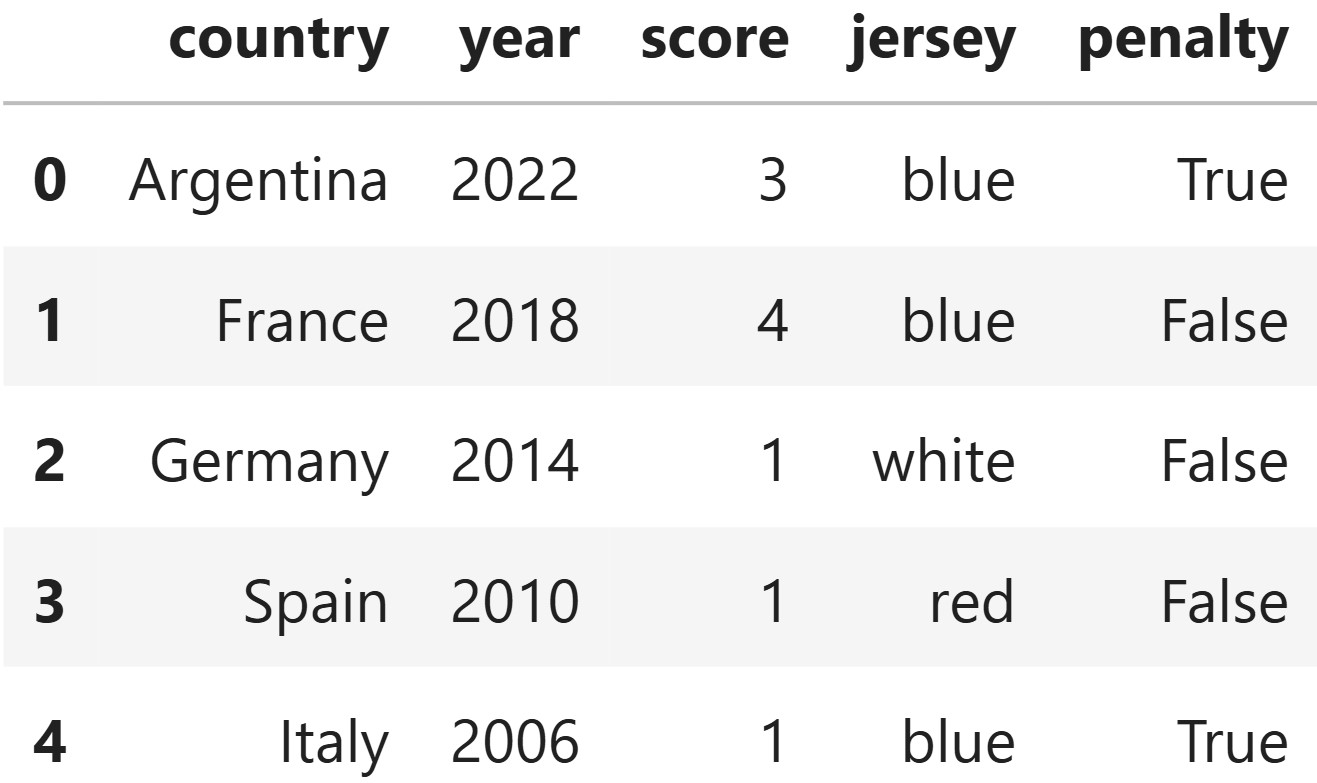
The World Cup is a large international soccer tournament that takes place every 4 years. There have been 22 World Cups in total, and the next one is coming up soon in June 2026!
The wc DataFrame lists all 22 World Cup winners, in
reverse chronological order. Each row has the name of the winning
"country" (str), the tournament
"year" (int), the winning team’s
"score" (int), and the color of the winning
team’s "jersey" (str). The last column,
"penalty" (bool), is True if the
game was tied at the end of regular play and the winner was determined
by a tiebreaker, called a “penalty shoot-out.” The first few rows of
wc are shown below, though wc has more rows
than pictured.
Assume that we have already run import babypandas as bpd
and import numpy as np.
Suppose we define x as follows.
x = wc.get(["year", "score"]).groupby("year").mean().shape[0]Choose the expression below that evaluates to True.
x < wc.shape[0]
x == wc.shape[0]
x > wc.shape[0]
Answer: x == wc.shape[0]
The average score on this problem was 69%.
Fill in the blanks so the expression below evaluates to the name of the country with the most World Cup wins.
wc.groupby(__(a)__).__(b)__.sort_values(by=__(c)__, ascending=True).__(d)__(a): "country"
(b): count()
(c): any column name besides "country"
(d): index[-1]
The average score on this problem was 66%.
Kate wants to determine how often championships are won in penalty shoot-outs versus won in regular time. Which plot type would best allow her to visualize this information?
scatter plot
bar chart
line plot
Answer: bar chart
The average score on this problem was 82%.
Bianca creates a horizontal bar chart to show how times a World Cup
was won by a team wearing each jersey color. Based on the provided
information, what is the maximum possible length of the
"blue" bar? Give your answer as an
integer.
Answer: 20
The average score on this problem was 48%.
For each part below, determine the data type of the result, or state that the expression errors. If you can determine the exact value of the result, give it.
(np.arange(5) + "5")[-1]
int
float
bool
error
Answer: error
The average score on this problem was 88%.
np.sum(np.arange(1, 9, 3) * 3)
int
float
bool
error
Answer: int
Value: 36
The average score on this problem was 78%.
(wc.shape[1] / wc.get("score").iloc[2])
int
float
bool
error
Answer: float
Value: 5.0
The average score on this problem was 72%.
(wc.set_index("country").get("country").iloc[0])
int
float
bool
error
Answer: error
The average score on this problem was 78%.
Determine the value of best after running the code
below.
best = "Ronaldo"
a = "it's almost time for the World Cup!"
a = a.split(" ")[0]
m = "message"
m = m.title().replace("age", "i")
best = best[2] + best[-1] + " " + a + " " + mHint: We can access individual characters from a
string in the same way we access individual elements from an array. For
example, "hello"[4] is "o".
Answer: "no it's Messi"
The average score on this problem was 84%.