← return to practice.dsc10.com
This quiz was administered in-person. Students were allowed a
double-sided sheet of handwritten notes. Students had 20
minutes to work on the quiz.
This quiz covered Lectures
7-11 of the Winter
2025 offering of DSC 10.
Note (groupby / pandas 2.0): Pandas 2.0+ no longer
silently drops columns that can’t be aggregated after a
groupby, so code written for older pandas may behave
differently or raise errors. In these practice materials we use
.get() to select the column(s) we want after
.groupby(...).mean() (or other aggregations) so that our
solutions run on current pandas. On real exams you will not be penalized
for omitting .get() when the old behavior would have
produced the same answer.
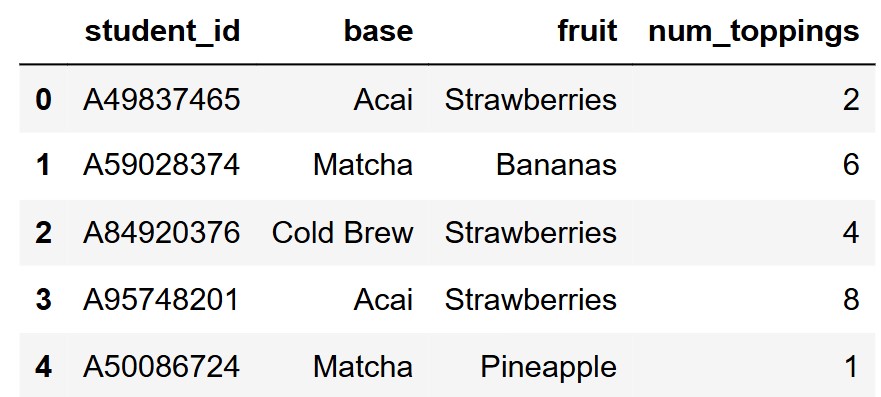
The DataFrame blue_bowl contains information about
orders placed by UCSD students at Blue Bowl, an on-campus eatery
specializing in custom bowls. For each order, we have the customer’s
"student_id", the "base" of their bowl, which
"fruit" they got, and the number of additional toppings,
"num_toppings". The first five rows are shown below.
Fill in the blanks so that the statement below outputs a DataFrame
showing the most popular base and fruit combinations in the
blue_bowl DataFrame, in descending order of popularity.
blue_bowl.groupby(__(a)__).__(b)__.sort_values(__(c)__)Answer (a): ['base', 'fruit']
The average score on this problem was 90%.
Answer (b): count()
The average score on this problem was 90%.
Answer (c):
"student_id", ascending = False
The average score on this problem was 84%.
Let five_bowls be the smaller DataFrame consisting of
only the first five rows of blue_bowl.
How many rows are in the DataFrame
five_bowls.merge(five_bowls, on="base")?
5
9
11
15
25
None of these
Answer: 9
The average score on this problem was 63%.
How many rows are in the DataFrame
five_bowls.merge(five_bowls, on="fruit")?
5
9
11
15
25
None of these
Answer: 11
The average score on this problem was 61%.
Suppose there are five available fruits: strawberries (red), bananas (yellow), raspberries (red), pomegranate (red), and pineapple (yellow). If Pranav orders a bowl with one fruit and tells you that the fruit is red, what is the probability he did not get strawberries?
Answer: 2/3
The average score on this problem was 84%.
The density histogram below shows the distribution of
"num_toppings" for 250 unique orders in
blue_bowl.
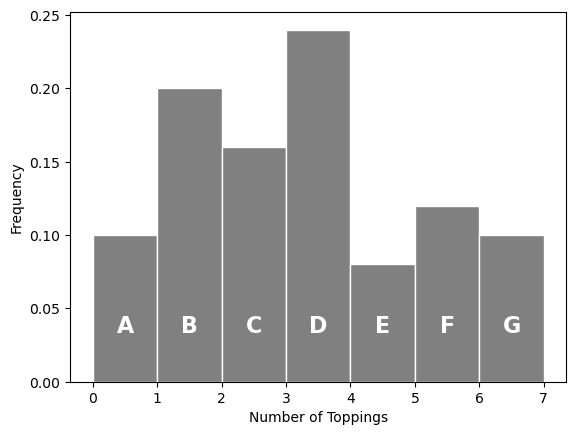
Kate orders a bowl with exactly two toppings. Which bin is her order included in?
A
B
C
D
E
F
G
Answer: C
The average score on this problem was 89%.
How many more orders were there with one topping than orders with no toppings? Give your answer as an integer rounded to the nearest multiple of 5.
Answer: 25
The average score on this problem was 81%.
Fill in the body of the function prep_time such that
both expressions below evaluate to the same Series.
    blue_bowl.get("num_toppings").apply(prep_time)

    1.2 + 0.2 * blue_bowl.get("num_toppings")

    def prep_time(x):
return Answer: 1.2 + .2 * x
The average score on this problem was 80%.